The Biggest and Best High School Football Stadiums in Texas
As an Amazon Associate, Texas Journeys earns from qualifying purchases. Product links on this page may earn us a small commission at no extra cost to you.
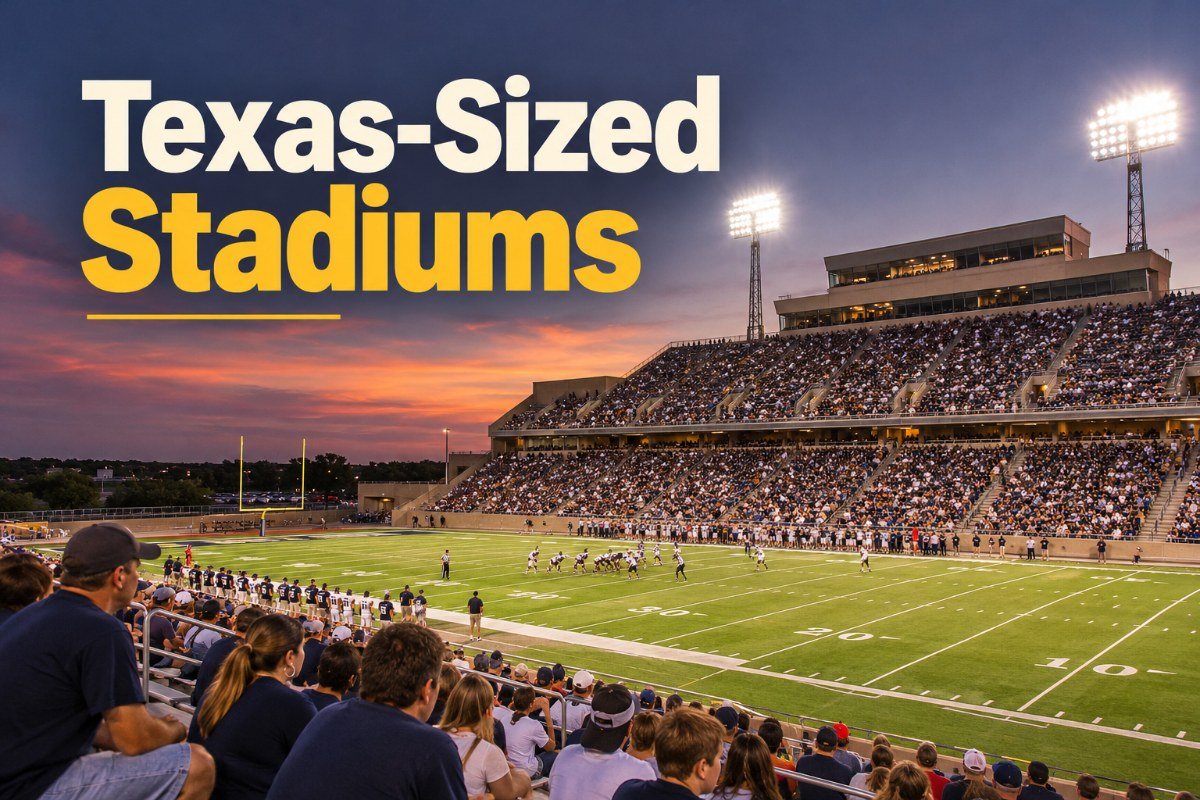
In most states, a high school football stadium is a set of bleachers and a scoreboard. In Texas, it can be a 19,000-seat concrete bowl, a $70 million complex with a video board bigger than some college stadiums, or a century-old landmark on a hill overlooking two countries. Here are the biggest and most famous high school football stadiums in Texas, what makes each one worth the drive, and how to make the most of a Friday night visit.
Why Texas high school stadiums are so big
Texas has more than 1,000 high schools playing UIL football, and in many towns the high school team is the only team in town. Districts in fast-growing suburbs around Dallas–Fort Worth and Houston have used bond elections to build stadiums that several high schools share, which is why many of the biggest venues are district-owned rather than tied to a single school. A smaller number, like Allen and Odessa, built big because the whole town turns out every Friday.
The biggest high school football stadiums in Texas
| Stadium | City | Approx. capacity | Opened | Known for |
|---|---|---|---|---|
| Memorial Stadium | Mesquite | 20,000 | 1977 | Long one of the largest high school venues in the state |
| Ratliff Stadium | Odessa | 19,302 | 1982 | Home of Permian and Odessa High; the Friday Night Lights stadium |
| Alamo Stadium | San Antonio | 18,500 | 1940 | Historic WPA-era stone stadium for San Antonio ISD |
| Farrington Field | Fort Worth | 18,500 | 1939 | Art Deco landmark for Fort Worth ISD |
| Eagle Stadium | Allen | 18,000 | 2012 | Largest Texas stadium serving a single high school |
| Buccaneer Stadium | Corpus Christi | 18,000 | Mid-1900s | Coastal Bend’s big Friday night venue |
| San Angelo Stadium | San Angelo | 17,500 | 1962 | Built into a natural bowl; home of the Central Bobcats |
Capacities are approximate and change with renovations. Sources: KEEL, KXAN, Eagle Stadium (Wikipedia).
Ratliff Stadium, Odessa: the epicenter
If you only visit one stadium on this list, make it Ratliff. Opened in 1982 for about $5.6 million, it seats more than 19,000 and is shared by Odessa Permian and Odessa High. This is where the 1988 Permian Panthers played the season H.G. Bissinger wrote about in Friday Night Lights. On big nights fans still line up hours early, and the “MOJO” chant from the Permian side is something you feel in your chest.
Visitor tip: Permian–Midland Legacy and Permian–Odessa High games sell out. Buy tickets online the week of the game and arrive at least an hour before kickoff.
Eagle Stadium, Allen: the $60 million showplace
Allen’s Eagle Stadium opened on August 31, 2012, with a win over Southlake Carroll. It cost just under $60 million and seats 18,000, making it the largest Texas stadium that serves only one high school. It made national news in 2014 when cracks in the concrete closed it for more than a year; the builder and architect paid for more than $10 million in repairs, and it reopened in June 2015. Under the stands are a wrestling room, a weight room and even a golf practice area, and the Allen Escadrille marching band, one of the largest in the country, has 1,000 reserved seats of its own.
The modern “mega-stadiums” of the suburbs
Several Texas districts have built stadiums that rival small colleges. They are smaller in seats than Ratliff or Eagle Stadium, but they lead the state in price tag and amenities:
- Cy-Fair FCU Stadium (Cypress), about $80 million, 11,000 seats. Part of the Berry Center complex, which also has an arena and a theater.
- Legacy Stadium (Katy), about $70 million, 12,000 seats, opened 2017. Katy ISD’s showpiece, with a huge HD video board and a two-level press box. Katy High has one of the strongest title histories in the state, so the atmosphere is earned.
- McKinney ISD Stadium (McKinney), about $70 million, 12,000 seats, opened 2018. Uses LED lights with glare visors to protect the neighborhood.
- Children’s Health Stadium (Prosper), about $48 million, 12,000 seats. One of the newer venues in the fast-growing northern DFW suburbs.
Cost figures: CBS Sports.
The historic and the unforgettable
Size isn’t everything. These smaller stadiums are worth a road trip for their history and setting:
- R.R. Jones Stadium, El Paso. Opened in 1916 and nicknamed “The Lady on the Hill,” it looks out over downtown El Paso and Ciudad Juárez.
- Munson Stadium, Denison. Home of the Battle of the Ax between Denison and Sherman, one of the oldest rivalries in Texas.
- Rogan Field, San Saba. Built in 1935 on the site of an old graveyard and still nicknamed “The Graveyard.”
- House Park, Austin. A small downtown stadium with views of the Austin skyline, shared by several Austin ISD schools.
- Sanderson’s home field. One of the smallest stadiums in the state, about 700 seats, in a far West Texas town that fields both an 11-man and a six-man team.
How to plan a Texas stadium road trip
- Check the schedule. Most varsity games are Friday at 7 or 7:30 p.m., with some Thursday and Saturday games at shared district stadiums. The school district’s athletics site lists home games.
- Buy tickets online. Many districts have gone cashless and sell through apps like HomeTown Ticketing. Regular-season tickets usually cost less than a movie.
- Pick a big game. Rivalry weeks, homecoming and the first round of the playoffs bring the biggest crowds and the best band shows.
- Stay for halftime. In Texas the band is half the show.
- Pair it with the town. Odessa means a stop at a Permian Basin Tex-Mex joint, San Antonio means Alamo Stadium plus the River Walk, and El Paso means sunset views from the Lady on the Hill.
What to bring to a big Texas stadium
Concrete bleachers get hard by the third quarter, and many of these stadiums have clear-bag rules. A few things make the night a lot better:
- A stadium seat with back support clips onto bleachers and saves your back over four quarters.
- A clear stadium-approved bag gets you through the gate fast at districts with bag rules.
- Compact binoculars help in the upper rows at Ratliff or Eagle Stadium.
- A small power bank keeps your phone alive for digital tickets and photos.
Which stadium should you visit first?
For history and atmosphere, Ratliff Stadium in Odessa is the one every Texas football fan should see once. For sheer spectacle, catch a game at Allen’s Eagle Stadium or Katy’s Legacy Stadium. And for the small-town Texas experience, find a Friday night in a place like San Saba or Sanderson, where the whole town is in the stands.
Have a favorite stadium we missed? Tell us on the Texas Journeys Facebook page and we may add it to the list.
Read next: How the UIL Football Playoffs Work and The Greatest Rivalries in Texas High School Football.
Get More Texas in Your Inbox
Road trips, Texas food, festivals and Friday night football, sent straight to you. No spam, ever.